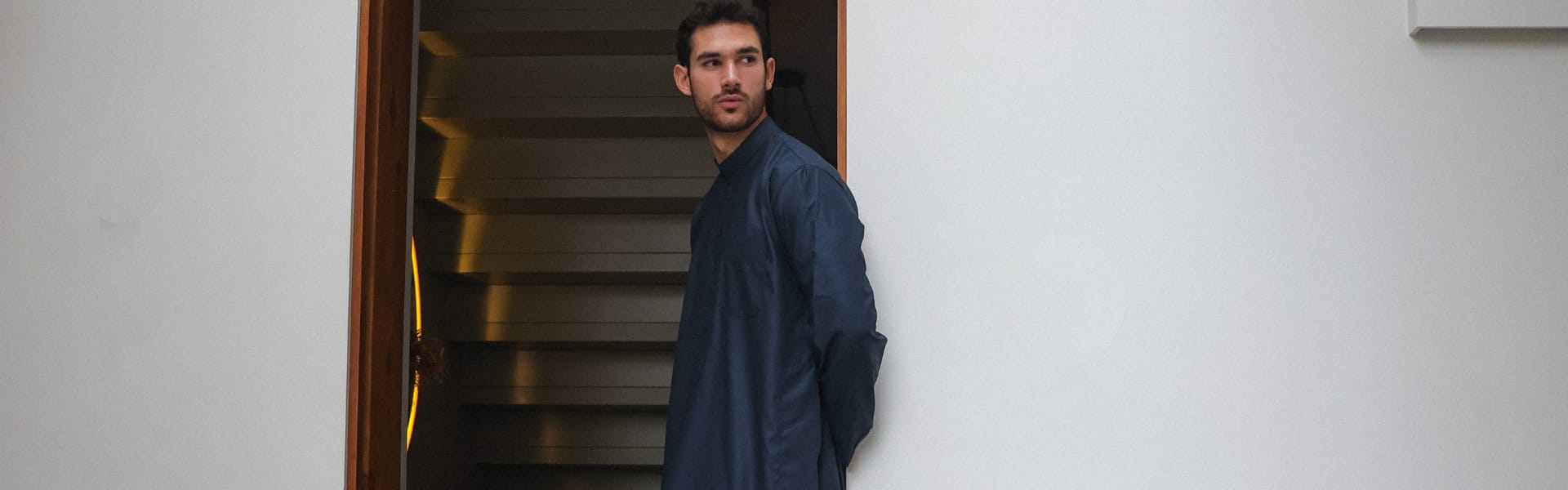



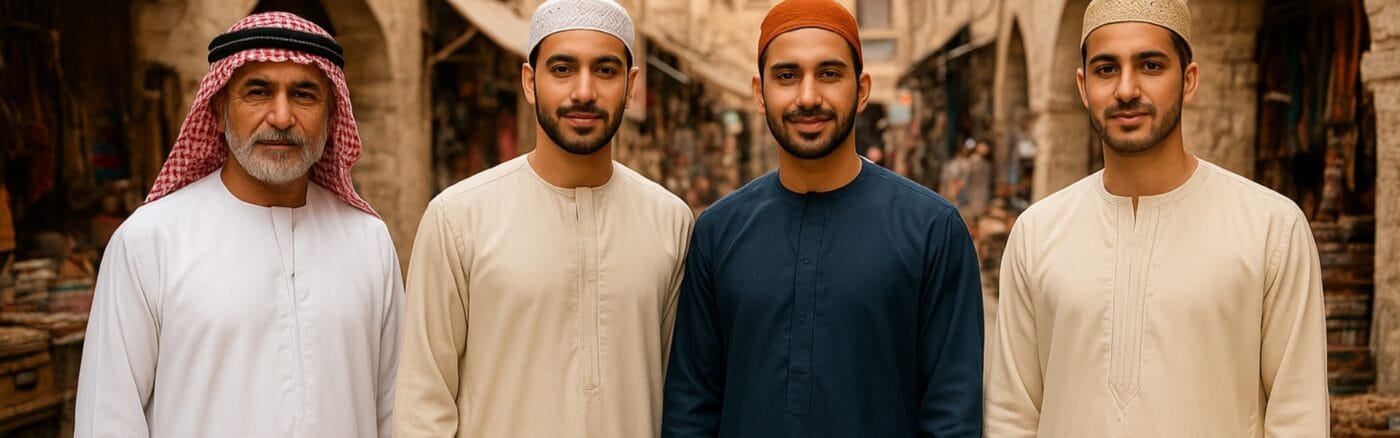
The thobe takes many forms across Muslim communities, with each region shaping it through its own climate, history, and craftsmanship. In the deserts of Arabia, the streets of the Levant, and the markets of North Africa, every version reflects a distinct expression of culture and identity.
Saudi Arabia
The Saudi thobe is known for its structure and elegance. Typically white, with a stiff collar and buttoned cuffs, it is tailored with precision and worn daily by men across the country. In summer, it is made from lightweight cotton to suit temperatures that can exceed forty-five degrees Celsius. During cooler months, darker shades such as grey and navy are common.
Saudi men often complete the look with a ghutra, the red-and-white or plain white headscarf, and an agal, the black cord that secures it. The national preference for clean lines and crisp fabric reflects the country’s focus on refinement and presentation.
United Arab Emirates
In the Emirates, the thobe is known as the kandura. It has a looser neckline than the Saudi version and usually no buttons. The fabric is exceptionally light to match the coastal humidity, and a long decorative cord, the tarboosh, hangs from the collar. The kandura is almost always white, with subtle differences in tone marking regional identity.
Abu Dhabi styles often feature bright white shades, while those in Dubai or Sharjah lean towards ivory or cream. The simplicity of the Emirati kandura is deliberate, representing modesty and balance.
Oman
The Omani dishdasha is one of the most distinctive thobe styles in the Arab world. It has a rounded neckline and a short tassel known as the furakha or tarboosh. Traditionally, men perfume the tassel with frankincense or oud before wearing it for prayer or social gatherings.
Omani thobes come in a wide range of colours, including white, beige, grey and soft brown. They are often worn with the kuma, a hand-embroidered cap, or the massar, a folded turban. The attention to detail in embroidery and stitching reflects Oman’s long history of textile craftsmanship.
Qatar and Kuwait
Qatari thobes resemble the Saudi style but with a slightly softer collar and a looser fit. High-quality synthetic fabrics are popular because they hold shape during long working days. In Kuwait, the design is simpler and often paired with a light cloak called a bisht for formal occasions. Both styles reflect Gulf elegance, where tailoring is an important aspect of men’s fashion.
Morocco
In North Africa, the thobe takes on a very different form. Moroccan men wear a djellaba, a long, loose robe with a pointed hood called a qob. It is usually made from cotton or wool depending on the season. The djellaba often features decorative stitching along the seams and is worn over lighter garments for warmth in the Atlas mountain regions.
In urban areas such as Casablanca and Fez, neutral shades such as cream and sand are common, while in rural communities, earthy tones or stripes remain traditional. The Moroccan djellaba represents practicality and elegance combined, adapted to both desert heat and cool mountain air.
Egypt and Sudan
In Egypt, the equivalent of the thobe is the galabeya, which has a wide cut and loose sleeves. Egyptian men often wear darker colours such as olive, brown or navy, especially in the Nile Valley. The galabeya’s roomy design makes it ideal for agricultural work and hot weather.
In Sudan, men wear a similar garment called the jellabiya, often paired with a turban and shawl. The Sudanese version tends to be pure white and is usually made from crisp cotton. Its simple design mirrors the climate and the practical lifestyle of the region.
Somalia and East Africa
In Somalia, the thobe is worn mainly during prayers and special occasions. The style resembles the Gulf design, often in white or cream, but with regional touches such as embroidery around the collar and cuffs. In coastal cities such as Mogadishu, the fabric is light and airy, suitable for high humidity.
Across East Africa, particularly in Tanzania and Kenya, the thobe is influenced by both Arab and Swahili culture. It is often paired with the kofia, a short embroidered cap that reflects Islamic identity.
South Asia
In countries such as Pakistan, India and Bangladesh, men traditionally wear the shalwar kameez or kurta, though the thobe is also worn by those returning from Hajj or Umrah. In coastal areas with Arab influence, such as Kerala in southern India, the thobe has been adopted as daily wear, often made from crisp white cotton.
A Global Garment
Though designs differ, the thobe carries the same essence across borders. It stands for modesty, respect and unity within Muslim identity. From the finely stitched collars of Riyadh to the flowing robes of Marrakech, every version is an expression of culture shaped by geography, craftsmanship and belief.
